Your own website does not have to be the page people find first. A useful article on another platform can introduce readers to your work before they ever visit your domain.
That is the interesting idea behind parasite SEO. The less interesting version is the promise that publishing a few pages on a big website will automatically bring traffic, valuable backlinks, and easy money.
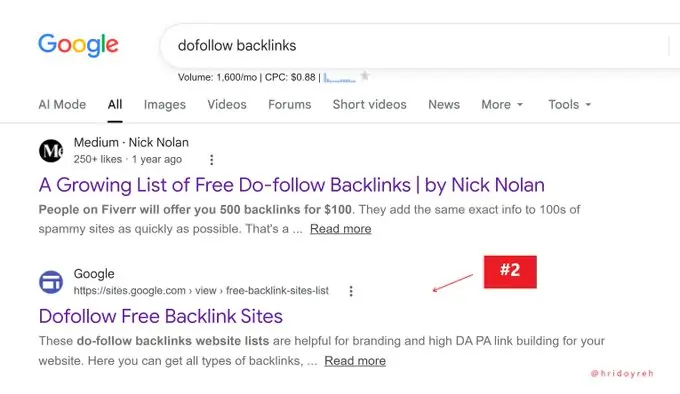
The posts shared by Hridoy Reh on X bring both sides into the discussion. The supplied screenshot shows a Google Sites page below a Medium article for the search “dofollow backlinks.” The Google Sites result is marked “#2.” The accompanying excerpts mention Google Docs, the Chrome Web Store, and Google's Search Console Community. Hridoy Reh on X
It is an interesting starting point. It is not a complete case study.
What is parasite SEO?
Parasite SEO means publishing content on an established third-party website with the aim of benefiting from its existing search visibility and ranking signals. Instead of trying to rank a page on your own domain, you try to get the externally hosted page found. The term is used broadly, including for very different forms of third-party publishing. Ahrefs: Parasite SEO
Imagine writing a detailed tutorial for an established industry publication. Someone discovers that tutorial through Google, reads it, and then visits your website to explore your project.
The important distinction: the external article ranks first. Your own website does not automatically rank better because that article exists.
That separates two goals often mixed together: getting readers through another website, and building links that might influence your own search rankings.
What the screenshot does—and does not—prove
The screenshot shows a Google Sites result in a prominent position in that particular view. It does not tell us how long the page stayed there, what traffic it received, or whether anyone bought anything afterward.
We also cannot use it to establish why the page ranked. Google describes ranking as primarily page-based, while also using site-wide signals. Strong signals for a website do not mean every page on it will rank well. Google: Search ranking systems
My takeaway is not “Google Sites gets a special ranking bonus.” It is simpler: do not dismiss a page because its publishing platform looks basic.
But do not confuse easy publishing with easy rankings either. Google does not guarantee crawling, indexing, or appearing in search results—even for pages that follow its guidelines. Google: How Search works
The four ideas from the posts, examined
Google Sites: a practical publishing option
Google Sites allows you to publish a website and make it publicly accessible. For a page intended to appear in search, check that the published site is public and that you have not enabled the option requesting exclusion from public search engines. Google Sites: Publish and share
I would use it for a genuinely useful resource: a focused guide, a project explanation, or a collection of original instructions. Not a page containing three generic paragraphs and a large button sending everyone elsewhere.
Public access creates the possibility of discovery. It does not establish that the page is indexed or competitive.
Google Docs: publish a resource, not just a link
Google Docs has a File → Share → Publish to web option. Publishing produces a separate viewing URL; it is not the same action as sharing an editing link. Account settings can restrict publication, and private information needs to stay out of publicly published documents. Google Docs: Publish to the web
A checklist or a reusable template could make sense here. My question would be: does the document help someone even before they click through to my website?
The fact that it is hosted by Google is not, by itself, evidence that it will rank or pass valuable ranking credit.
Chrome Web Store: build a real extension
This is the idea I find most interesting from a developer's perspective. For example, an extension could display page headings or help users inspect links.
But an extension is a product, not just a container for a backlink. The Chrome Web Store requires useful functionality and can reject low-value extensions or take action against spam. Publishing also requires developer registration and a one-time registration fee, so the “completely free backlink” framing leaves something out. Chrome Web Store: Program policies Chrome Web Store: Developer registration
I would judge this by whether people actually use the extension. Any additional visibility should follow from a useful tool—not replace the need to build one.
Search Console Community: do not invent a problem
One supplied excerpt suggests asking a question about your website and pretending not to know the answer so you can place a link.
I would not recommend that.
Google's help communities prohibit promotional spam, irrelevant posts, and deceptive behavior. A real support question with a necessary example URL is different from fabricating a question for advertising. Google Help Communities: Content policy
Help people or ask for genuine help. Do not manufacture a support issue to collect a link.
And what about Medium? It appears in the screenshot, but its rules also matter. Medium explicitly prohibits content posted primarily to send traffic to an external website or increase its search rankings. A complete article written for Medium readers is a different proposition from using the platform as a traffic funnel. Medium: Rules
A link on Google infrastructure is not a recommendation from Google
When you add a link to your own Google document, you are still the person placing that link. Google has not editorially selected your business simply because it hosts the document.
The term “dofollow” does not settle the question of value either. Google documents nofollow, ugc for user-generated links, and sponsored for paid placements. It treats these attributes as hints when evaluating links. The actual page and link need checking; a platform name alone cannot tell you how a particular link is marked or used. Google: Qualify outbound links Google: How link attributes are treated
My practical test: would I still want this placement if the link contributed nothing to my rankings?
If the answer is yes because relevant people read it and visit my work, there is an understandable reason to publish there.
What Google's rules say in 2026
Google's site reputation policy addresses third-party content published mainly to benefit from a host's established ranking signals. Third-party content itself is not automatically a violation; the policy expressly distinguishes examples such as user-generated platforms and editorial work. Link spam is a separate issue: creating links primarily to manipulate rankings can also violate Google's policies. Google: Spam policies
There is an important recent change. Google announced an update on August 28, 2026, effective August 30. For searches outside the European Economic Area, manual actions under this policy can affect the relevant section. For searches inside the EEA, that manual-action impact does not apply; Google may instead separate the section so it ranks independently. The distinction concerns the searcher's location, not simply where the publisher is based. Google: Site reputation policy update, August 2026
That is not a reliable loophole. If your strategy depends on borrowing another site's reputation, having your content evaluated independently undermines the very advantage you were seeking.
How I would approach it
I would start with a real question, not a list of supposedly powerful domains.
Take “how to create a website for an animal shelter.” A useful guide could explain what pages are needed, how to present animals clearly, and how volunteers can keep the information updated.
First, I would inspect the actual search results. Are they answering the question? What is missing? Does a suitable publication or platform already serve those readers? I would not assume a topic is easy to rank for just because it sounds specific.
Then I would create a complete resource for that audience, check the platform's rules, and disclose any connection to a product I mention. A relevant link can offer an additional tool or example, but readers should not have to leave merely to obtain the answer promised by the title.
Finally, I would measure useful outcomes: visits from the article, sign-ups, inquiries, or sales. Those are the results I would use to decide whether the work deserves more time—not the number of self-created links.
Can it make $1,000 a month?
That figure appears in the supplied discussion. The provided material does not contain verified revenue records or a complete path from rankings to sales.
Here is a deliberately hypothetical example—not a conversion benchmark. Suppose an article gets 1,000 visits. Ten percent click through to your website: 100 people. Two percent of those buy: two sales. At $50 commission per sale, that is $100 before costs, not $1,000.
The point is not that these percentages are typical. They are invented to show the steps missing from an earnings claim. You need evidence for traffic, onward clicks, purchases, and the value of each purchase.
My take: use other platforms, but keep building your own site
I am interested in useful publishing and useful tools. I am much less interested in collecting links on famous domains just to make a report look impressive.
An external platform can be a place to reach readers. But it also means depending on another operator's rules and control over the page. Ahrefs: Parasite SEO
For me, the sensible approach is to keep the main project and its most important resources on my own website, then contribute elsewhere where the content genuinely belongs.
Build something useful. Publish it where it helps people. Treat extra search visibility as an opportunity—not a guarantee.
Source note: The X example is based on supplied excerpts and the screenshot. The linked video could not be reviewed in full; the specific ranking and earnings were not independently verified. Policy information checked on September 26, 2026.